Element 3 Question 3-30D6
C3D30: Op Amps
In the op-amp oscillator circuit shown in Figure 3D6, what would be the most noticeable effect if the capacitance of C were suddenly doubled?
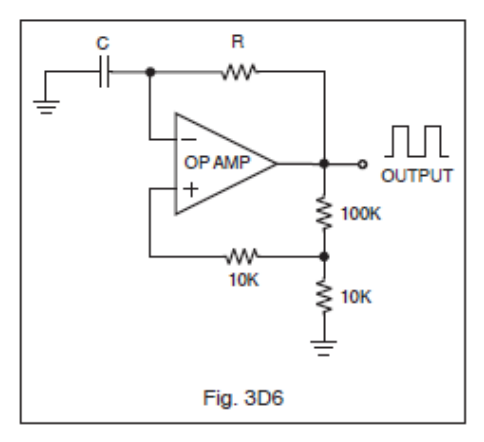
- Frequency would be lower. (correct answer)
- Frequency would be higher.
- There would be no change. The inputs are reversed, therefore the circuit can not function.
- None of the above.
Correct answer: A, Frequency would be lower.
Explanation
This is an op-amp relaxation (astable) oscillator. C charges through R from the output until the voltage at the inverting input passes the threshold set by the resistor divider feeding the non-inverting input. The output then switches state and C charges the other way. The period is proportional to the RC time constant, so doubling C doubles the period and halves the frequency (f is proportional to 1/RC).
Why the other answers are wrong
- B, Frequency would be higher.: This gets the relationship backwards. A larger capacitor takes longer to charge to the threshold, so the period gets longer and the frequency drops.
- C, There would be no change. The inputs are reversed, therefore the circuit can not function.: The inputs are wired correctly: RC timing goes to the inverting input and positive feedback from the divider goes to the non-inverting input. A change in C does change the frequency.
- D, None of the above.: A specific effect does occur: the frequency falls in inverse proportion to C. So 'none of the above' is wrong.