Element 8 Question 8-20C1
C8C20: Mixers
The diagram in Fig. 8C9 shows a simplified RADAR mixer circuit using a crystal diode as the first detector. What is the output of the circuit when no echoes are being received?
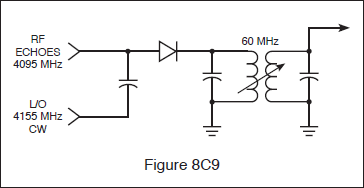
- 60 MHz CW.
- 4095 MHz CW.
- 4155 MHz CW.
- No output is developed. (correct answer)
Correct answer: D, No output is developed.
Explanation
A diode mixer produces the difference frequency only when two signals are present together. Here 4155 MHz − 4095 MHz = 60 MHz, the IF the output transformer is tuned to. With no echoes, only the local oscillator reaches the crystal. It just rectifies to a steady DC bias, which the 60 MHz tuned circuit won't pass, so no IF output is produced. IF energy appears only while echo pulses are arriving.
Why the other answers are wrong
- A, 60 MHz CW.: 60 MHz is the difference product of echo and local oscillator. Without an echo, there is nothing for the local oscillator to beat against.
- B, 4095 MHz CW.: 4095 MHz is the echo frequency itself, which by definition is absent. Even if present, the 60 MHz tuned output would reject it.
- C, 4155 MHz CW.: The 4155 MHz local oscillator does reach the diode, but the bypass capacitor and the 60 MHz tuned transformer keep it out of the output.