Amateur Extra Question E7G09
E7G: Operational amplifiers: characteristics and applications
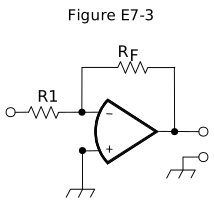
What will be the output voltage of the circuit shown in Figure E7-3 if R1 is 1,000 ohms, RF is 10,000 ohms, and 0.23 volts DC is applied to the input?
- 0.23 volts
- 2.3 volts
- -0.23 volts
- -2.3 volts (correct answer)
Correct answer: D, -2.3 volts
Explanation
Figure E7-3 is an inverting op-amp amplifier. The input goes through R1 to the inverting input, RF feeds the output back to that input, and the non-inverting input is grounded. The gain is -RF / R1 = -10,000 Ω / 1,000 Ω = -10. So Vout = -10 x 0.23 V = -2.3 V. The minus sign means the output has the opposite polarity from the input.
Why the other answers are wrong
- A, 0.23 volts: 0.23 V would mean a gain of +1, as in a voltage follower; this circuit has gain set by RF/R1 and inverts the signal.
- B, 2.3 volts: 2.3 V has the right size but the wrong sign; a signal fed to the inverting input comes out with the opposite polarity.
- C, -0.23 volts: -0.23 V gets the inversion right but leaves out the gain of 10 set by the 10,000 Ω to 1,000 Ω resistor ratio.