Amateur Extra Question E9B01
E9B: Antenna patterns and designs: azimuth and elevation patterns; gain as a function of pattern; antenna modeling
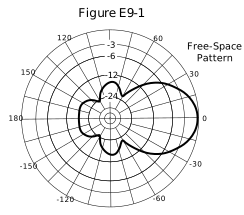
What is the 3 dB beamwidth of the antenna radiation pattern shown in Figure E9-1?
- 75 degrees
- 50 degrees (correct answer)
- 25 degrees
- 30 degrees
Correct answer: B, 50 degrees
Explanation
Beamwidth is the angle between the two points on either side of the main lobe where the pattern drops 3 dB below its peak (half power). In Figure E9-1 the main lobe points toward 0° and crosses the -3 dB ring about 25° above and 25° below that axis. The total beamwidth is 25° + 25° = 50°. A narrower beamwidth goes with higher gain.
Why the other answers are wrong
- A, 75 degrees: 75° would put the half-power points near ±37°, but by that angle the pattern has dropped well below -3 dB, close to the -6 dB ring.
- C, 25 degrees: 25° is the angle from the center of the lobe to just one -3 dB point. Beamwidth spans both sides, so double it to get 50°.
- D, 30 degrees: 30° is narrower than the lobe actually is. The -3 dB crossings are near ±25°, so 30° matches neither the full width (about 50°) nor the half-angle (about 25°).