Element 3 Question 3-10B4
C3B10: Ohm’s Law-2
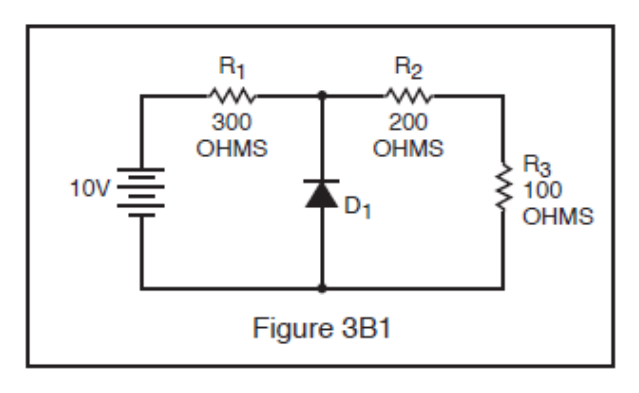
In Figure 3B1, what is the voltage drop across R1?
- 9 volts.
- 7 volts.
- 5 volts. (correct answer)
- 3 volts.
Correct answer: C, 5 volts.
Explanation
D1's cathode faces the battery's positive terminal, so the diode is reverse-biased and passes no current. Treat it as an open circuit. R1, R2 and R3 then form one series loop: I = E / R = 10 V / (300 + 200 + 100) Ω = 10 V / 600 Ω ≈ 16.7 mA. The drop is V(R1) = I × R1 = 0.0167 A × 300 Ω = 5 V. Shortcut: R1 is half the total resistance, so it drops half the supply.
Why the other answers are wrong
- A, 9 volts.: About 9 V (10 V minus a 0.7 V diode drop) is what you'd get if D1 were forward-biased and clamping its node. Its cathode faces the positive side, so it doesn't conduct.
- B, 7 volts.: 7 V would mean R1 takes 70% of the supply. Its 300 Ω is exactly half of the 600 Ω series total, so it drops half the supply: 5 V.
- D, 3 volts.: About 3.3 V is the drop across R2 (200 Ω × 16.7 mA), not R1. Check that you applied Ohm's law to the right resistor.