Amateur Extra Question E7B12
E7B: Amplifiers: class of operation; vacuum tube and solid-state circuits; distortion and intermodulation; spurious and parasitic suppression; switching-type amplifiers
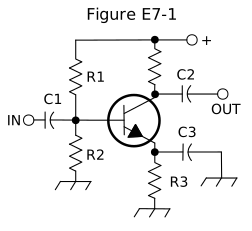
What type of amplifier circuit is shown in Figure E7-1?
- Common base
- Common collector
- Common emitter (correct answer)
- Emitter follower
Correct answer: C, Common emitter
Explanation
To identify an amplifier configuration, find the terminal that is common to input and output. In Figure E7-1, the signal enters at the base through C1 and leaves from the collector through C2. The emitter is tied to AC ground through bypass capacitor C3. Because the emitter is common to input and output, this is a common emitter amplifier. It gives voltage gain with a 180-degree phase inversion.
Why the other answers are wrong
- A, Common base: A common base amplifier feeds the signal into the emitter with the base at AC ground; here the input goes to the base.
- B, Common collector: A common collector stage takes its output from the emitter with the collector at AC ground; here the output comes from the collector and the emitter is bypassed.
- D, Emitter follower: Emitter follower is another name for common collector, which takes the output from the emitter; this circuit takes it from the collector.