Amateur Extra Question E7B11
E7B: Amplifiers: class of operation; vacuum tube and solid-state circuits; distortion and intermodulation; spurious and parasitic suppression; switching-type amplifiers
In Figure E7-1, what is the purpose of R3?
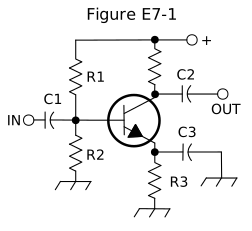
- Fixed bias
- Emitter bypass
- Output load resistor
- Self bias (correct answer)
Correct answer: D, Self bias
Explanation
R3 is the emitter resistor. Emitter current through R3 makes a voltage that subtracts from the base-emitter bias. If the current rises, from heat or from a high-gain transistor, the voltage across R3 rises and reduces the bias. That pulls the current back down. Because the transistor sets its own bias this way, it is called self bias. C3 bypasses R3 for AC so the gain is not reduced.
Why the other answers are wrong
- A, Fixed bias: Fixed bias means a base voltage set only by the supply network (R1 and R2); R3 changes the bias automatically as emitter current changes.
- B, Emitter bypass: The emitter bypass is capacitor C3, which shunts AC around R3; R3 itself is the DC bias resistor being bypassed.
- C, Output load resistor: The output load resistor sits in the collector circuit, where the output is taken through C2; R3 is in the emitter leg, going to ground.