Amateur Extra Question E9G06
E9G: The Smith chart
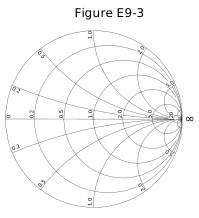
On the Smith chart shown in Figure E9-3, what is the name for the large outer circle on which the reactance arcs terminate?
- Prime axis
- Reactance axis (correct answer)
- Impedance axis
- Polar axis
Correct answer: B, Reactance axis
Explanation
A Smith chart has two named axes. The straight horizontal line is the resistance axis, where reactance is zero. The large outer circle is the reactance axis: every point on it has zero resistance and is pure reactance. That is why the constant-reactance arcs all end on it, each labeled with its value. Inductive reactance is in the upper half and capacitive in the lower half.
Why the other answers are wrong
- A, Prime axis: 'Prime axis' isn't a Smith chart term. The chart's center point (normalized 1.0) is sometimes called the prime center, but no circle is called an axis by that name.
- C, Impedance axis: 'Impedance axis' isn't a standard name. Impedances are plotted across the whole chart; the axes are named for resistance (the line) and reactance (the outer circle).
- D, Polar axis: A Smith chart is a polar plot of reflection coefficient, but its outer circle isn't called the polar axis. It is the reactance axis.